
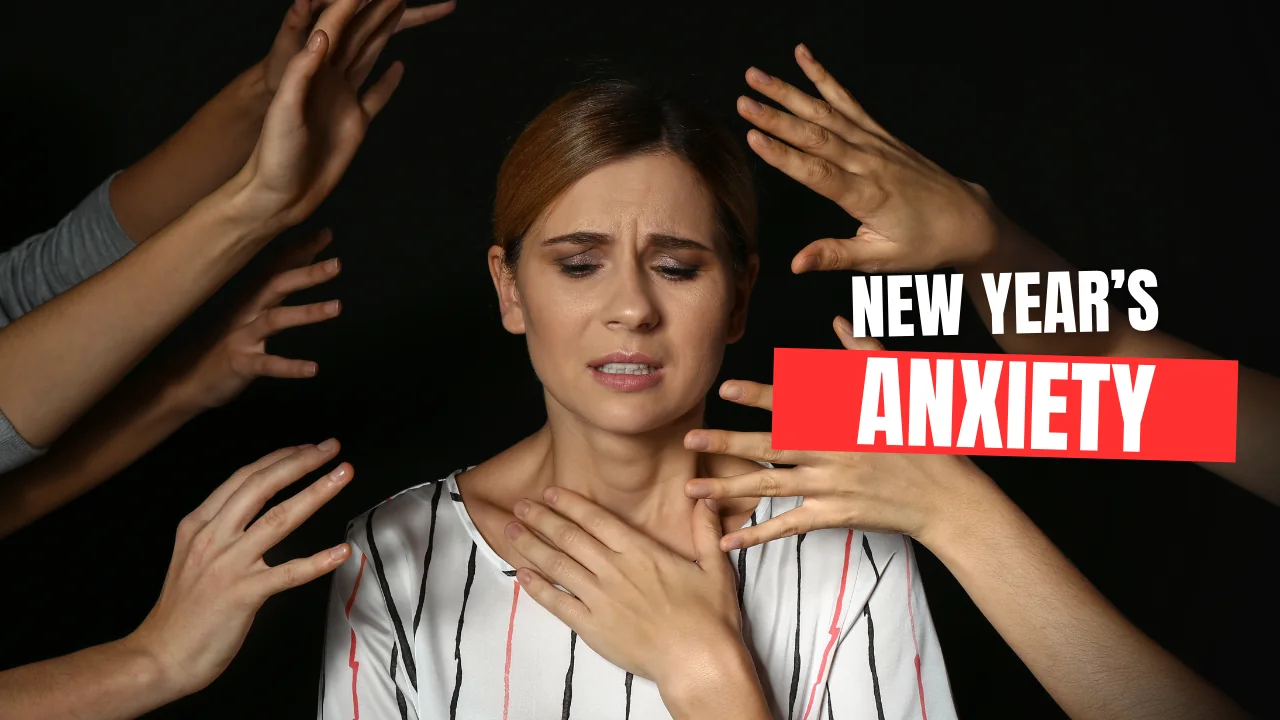
It’s mid-November. Christmas is still weeks away and you’re already tired. You sleep worse, you snap at people, and in your head a list keeps growing that nobody wrote: the presents, the dinner, the office Secret Santa, closing the year at work, the trip, New Year’s Eve, and that family gathering nobody wants to organize and that the same person always ends up organizing.
If you recognize yourself there, you’re not exaggerating. What’s happening to you has an explanation, and it has little to do with “not knowing how to enjoy the holidays”.
Why anxiety rises right now
Think about how you reach December. You’re carrying eleven months of work and unfinished business, and just when you have the least energy left, the calendar fills up more than at any other time of year. More spending, more commitments, more people, and fewer hours of sleep.
And here’s a detail almost all of us overlook: sleep.
In 2020, Eti Ben Simon and colleagues at the University of California, Berkeley kept a group of people awake for a whole night and measured their anxiety the next day. It went up clearly. Then they followed almost 400 people in their normal lives and saw the same thing on a smaller scale: the worse they slept one night, the more anxiety they reported the next day.
In plain words: December takes hours of sleep away from you, and with less sleep, anxiety has fewer brakes. It’s a loop that feeds itself.
Add expectations. In December everything has to be happy, close and perfect, and social media makes sure you remember it, with flawless tables and families who all smile at once. When your home doesn’t look like that photo, a strange pressure shows up, as if you were failing at something you never even chose.
And there’s money. The year-end bonus arrives and often disappears in a week on presents, food and tickets, while January’s long wait for payday is already showing in the background.
Why cancelling everything feels so good
When the list overwhelms you, you’ll probably feel like disappearing until January 2. You cancel a gathering, leave a message unanswered, push a task to later, and you feel instant relief.
In psychology we call that negative reinforcement. Unlike positive reinforcement, here you’re not chasing something pleasant: you’re escaping something that bothers you. And it turns out that when a behaviour gets you out of discomfort, you learn to repeat it every time that discomfort comes back.
The problem is that the relief doesn’t last. The task is still there, the message is still unanswered, and next time the anxiety arrives stronger, because you learned that the only way out was to run.
The same goes for the extra drink, the extra snack or the extra purchase. They calm you for a while, and that’s exactly why they get repeated.
What end-of-year anxiety looks like
It almost never introduces itself by name. It shows up as waking at three in the morning with your mind racing, as a clenched jaw, shoulders up by your ears or an upset stomach. It shows up as bad temper with the people you love most.
But wait, don’t get it wrong: none of that means something is wrong with you. That’s how a body responds when it has been carrying too much for too long.
What does help
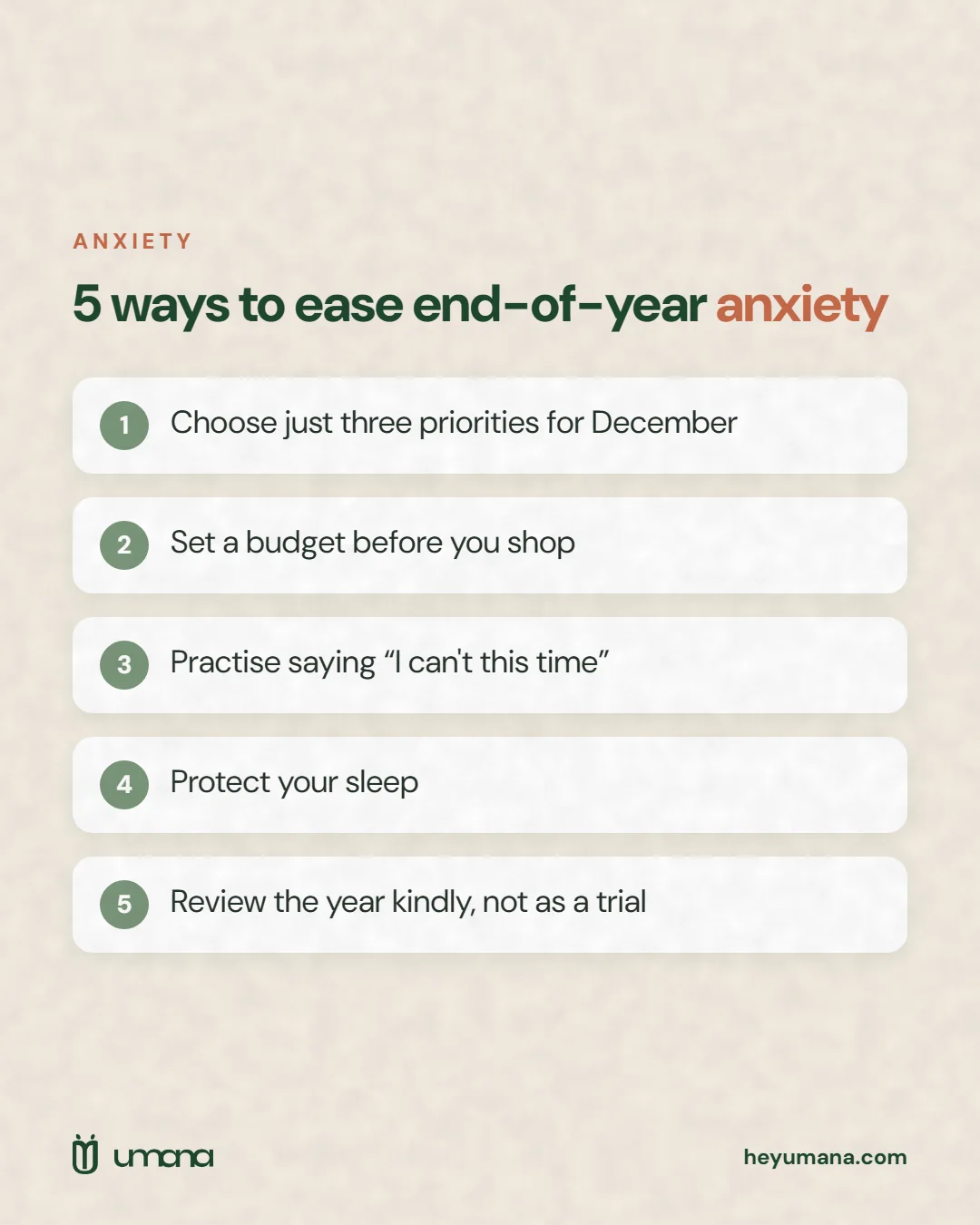
Take a sheet of paper and write down everything you think you have to do before the 31st. Everything, even if it’s embarrassing. Then mark only three things that really matter to you. The rest can be done halfway, handed to someone else or simply not done. December ends just the same even if the tree is crooked.
Before you go shopping, decide how much you can spend in total and split it up. Having a clear number saves you a lot of going round in circles. A small, well-chosen present is worth more than a debt that keeps you awake in February.
Have a sentence ready for saying no. You don’t have to go to every gathering, and a short answer works better than a long excuse: “Thanks for inviting me, I can’t make it this time, but I’d love to see you in January”.
Careful with this one: calmly choosing which gathering to skip is different from running away from everything because anxiety is winning. In the first case, you decide. In the second, the discomfort decides.
Look after your sleep the way you would an important appointment. Try to wake up at roughly the same time every day, even after a late dinner. If you struggle to sleep, the article on Sunday insomnia has techniques that also work in December.
And when the review of the year comes, change the questions. Instead of “what didn’t I achieve?”, try these: what did I learn this year? What held me up when things got rough? What do I want to take into next year?
A two-minute exercise for when everything speeds up
Put your feet on the floor and notice the contact. Breathe in through your nose for a count of four and breathe out through your mouth for a count of six. Keep it up for two minutes.
Why does it work? That rhythm leaves you at about six breaths per minute. In 2018, Andrea Zaccaro and colleagues reviewed the studies on slow breathing, below ten breaths per minute, and found it’s linked to more activity in the system that calms the body and to less anxiety. The authors themselves say it’s still debated exactly how it works, but the results point in the same direction.
When to ask for help
If the anxiety doesn’t ease once the holidays are over, if for weeks it stops you working or sleeping, or if you catch yourself using alcohol or other substances to get through, it’s worth talking to a professional. There’s no need to wait for January, let alone for everything to fall apart.
Now a question for you: of everything on your December list, what are you doing because you want to, and what are you doing just so the pressure stops for a while?
If you’d like to work on it with someone, at Umana you can start from your phone. Fill in the questionnaire to find your therapist and we’ll help you find the right person.
Sources: Ben Simon, Rossi, Harvey and Walker, 2020, Nature Human Behaviour. Zaccaro and colleagues, 2018, Frontiers in Human Neuroscience.

This article provides general information and is not medical or therapeutic advice. Mentions of diagnoses or therapy and treatment options are educational and do not mean they are available through Umana in your country.
Leave a Reply