
There is a question almost everyone asks before booking a first appointment and almost nobody says out loud: how much does an online therapist cost?
As if talking about money and sadness in the same sentence were bad manners, right? But think of it this way: before you take a pair of shoes to the till, you look at the price tag. Therapy asks for a lot more than shoes. It asks for time, willingness and, yes, money. So let’s talk numbers, what moves the price, and how to tell whether what you pay makes sense.
What a session costs in Ecuador
In Ecuador, a private in-person session costs around 40 to 55 dollars, depending on the city and the professional. With very sought-after specialists it can go higher. Public services, universities and community programmes can be free or much cheaper, almost always in exchange for a waiting list.
At Umana, a session in English costs 50 dollars, or 45 with the 4-session plan. Why does online therapy usually sit in the middle or lower part of the market? For a simple reason: costs a consulting room has simply disappear, such as rent, travel and dead time between one patient and the next. That lowers the price, not the quality. Quality depends on who sees you, not on whether there is a screen in between.
And there is a cost that is rarely added up: yours. The taxi or bus to the office, the hour you take off work, the person who looks after the children while you go. If you do the whole sum, the difference between an in-person and an online session is usually bigger than it looks.
What pushes the price up or down
There are five things, and it pays to know them before you compare one place with another.
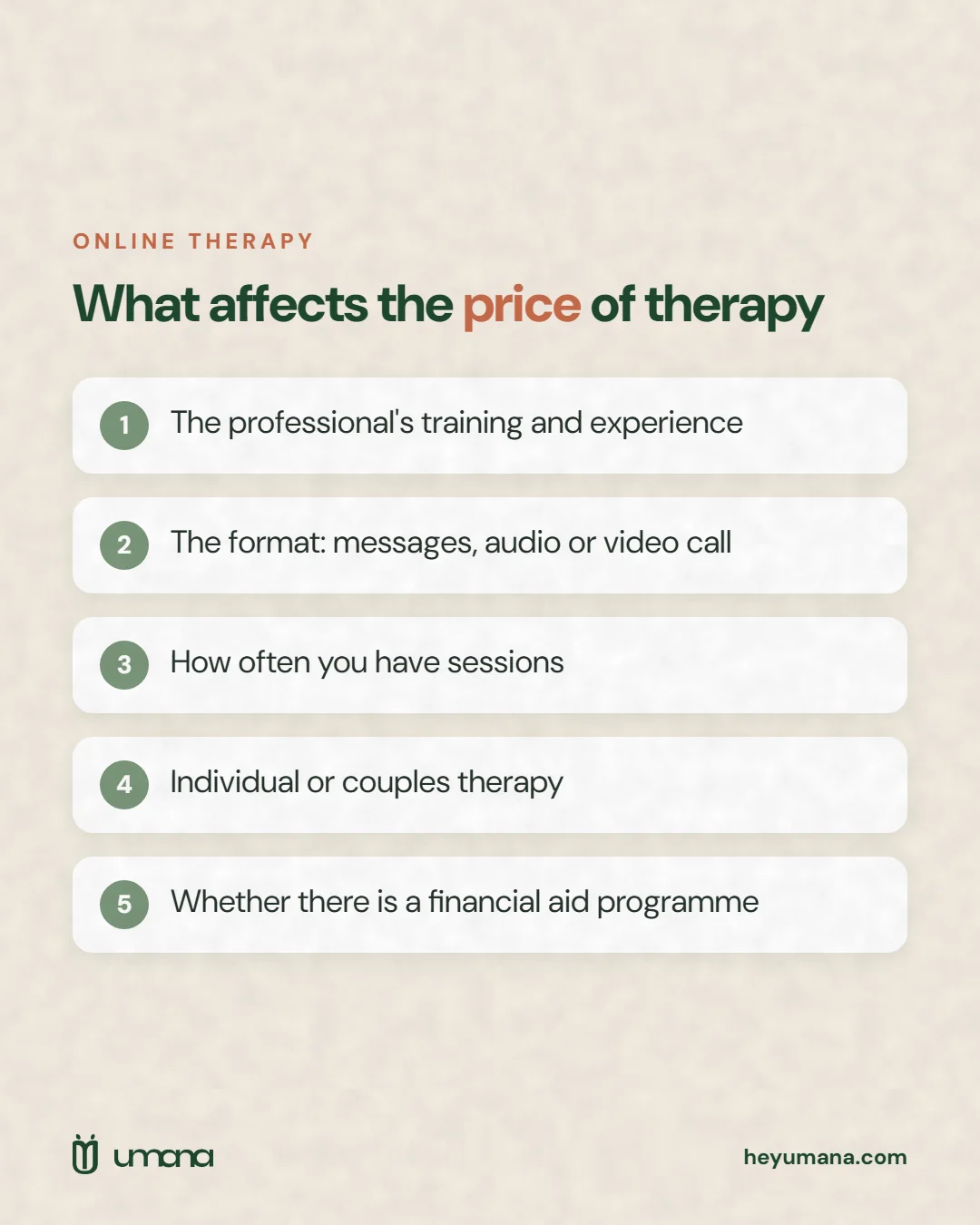
The training of the person who sees you. A psychologist with a master’s in couples work or trauma and years of practice will usually charge more than a recent graduate. That doesn’t automatically make them the best option for you. What matters is that they know how to work with exactly what you bring.
The format. Exchanging messages during the week and sitting for fifty minutes on a video call are different things. Some services mix both in one plan, and the final price changes with the combination.
The frequency. Many people start with one session a week and, once things calm down, move to one every two weeks. Paying session by session or with a plan doesn’t come to the same total at the end of the month either.
The type of therapy. Couples therapy usually costs a bit more, because sessions are longer and need different preparation. If that is what you are looking for, here is how our online couples therapy works.
Financial aid. Some services offer grants or discounts for people who can’t pay the full rate. Asking costs nothing, and nobody should feel ashamed to do it.
When to distrust a price, and how to tell if you pay a fair one
Is cheap therapy a false economy? Sometimes. I’d be wary of a ridiculously low price when nobody tells you who will see you: always ask whether the person is qualified and registered to practise. I’d also be wary of anyone who promises results in two or three sessions. Therapy can be brief, but no serious professional guarantees miracles. And a good service tells you the price before asking for your card and lets you pause or cancel without putting obstacles in your way.
Now, a fair price isn’t only measured before you start. After three or four sessions, ask yourself three questions in private. Do I feel my therapist listens to me and understands what is happening to me? Do I know where we are heading? Do I notice any change, even a small one? If the answer is yes, the money is doing its job. If not, talk about it with your therapist or ask for a change. At Umana you can change professional whenever you want, without giving reasons.
If you can’t afford it right now
It happens to a lot of people, and it doesn’t mean you have to manage alone. You have several doors. You can ask about financial aid: at Umana, the questionnaire has an option to see whether you qualify. Many psychology faculties offer low-cost care with students supervised by professionals. Public health services have waiting lists, but they are a real door. And one session every two weeks is better than none.
If you are in crisis, price comes second. In Ecuador call 911, and our crisis help page lists free helplines that answer at any hour.
The cost of not going
This is uncomfortable to say, but not going to therapy also has a price. You pay it in sleepless nights, in the same argument repeated every month, in lost working days, in the feeling of living on autopilot. It doesn’t appear on any bill, and yet you feel it every day.
So why is the first step so hard? There is a mechanism behind it called negative reinforcement. In plain words: every time you put the appointment off, you feel instant relief, because the discomfort of starting goes away. That relief makes putting it off more likely next time. The problem is still there. The only thing that leaves is the discomfort of the moment.
So the question isn’t only how much it costs to go. How much is not going already costing you?
If you want to know how much your process would cost at Umana, you can look at the online therapy page or, better still, fill in the questionnaire to find your therapist. It takes a few minutes and commits you to nothing.


This article provides general information and is not medical or therapeutic advice. Mentions of diagnoses or therapy and treatment options are educational and do not mean they are available through Umana in your country.