

Have you ever stopped to think carefully about what stress actually does to your life? The first things that come to mind are probably the usual ones: tiredness, an ache here or there. Well, let me tell you that is only the basics. Today you will learn how stress shows up in the body and why it can persist. We will also give you real strategies to protect your health from stress.
To understand it better, imagine two rats in two identical cages. Over the next few hours both will receive exactly the same number of electric shocks, of the same intensity, at the same time. If the damage depended only on the amount of stress, both rats should end up with the same consequences, the same problems.
In this example, the first rat has a wheel in its cage. If it turns the wheel when the shock comes, the shock stops. The second rat has no wheel or anything like it; its shocks are wired to the first rat’s, so it gets exactly the same thing at exactly the same moment, but it can do absolutely nothing about it. Whatever happens, this rat just waits and takes the shocks.
This experiment was carried out by the psychologist Jay Weiss in 1971. When it was over, he examined both rats and found significant differences. The first rat (the one with the wheel) showed no major after-effects; its stomach was almost untouched. The other rat’s stomach, by contrast, was full of ulcers.
Weiss observed that rats with control developed far fewer stress-related stomach lesions than those that could do nothing to change their situation. And that difference decided which of the two got sick.
What we need to learn about stress is this: often it is not the number of problems that affects us most, but the feeling that we can do nothing, that we can’t control what is happening to us and can’t change it. So instead of asking “how much stress do I have?”, maybe we should ask “which part of this situation is actually in my hands?”
What does stress depend on?

In the 1930s Hans Selye explained that our body reacts to stress in three stages. First comes alarm, when something puts us under strain and the body gets ready to respond. Then comes resistance, when we try to stay strong and adapt to the situation. But if the stress goes on for a long time, we reach exhaustion, because by then we no longer have enough energy to keep coping with it.
Selye was partly right: the body gets tired when it is under stress for a long time. But as we saw with Weiss’s experiment, it is not only tiredness, nor only the amount of pressure we are under, but also whether we feel we can do something to control or change the situation.
The brain, passivity and control
In 1967, Seligman and Maier ran an experiment with dogs. First they put them in an unpleasant situation they could not escape, however hard they tried. Then they put them in a box they could easily escape from. Yet many of the dogs didn’t even try; they simply stayed still, as if they had learned that whatever they did, they would not get away.
They called this phenomenon learned helplessness, and for many years it was thought that the animals learned their actions were useless and therefore stopped acting and trying.
But much later, in 2016, Seligman and Maier revisited their theory and reached a different conclusion. According to their new account, passivity is not something we learn. On the contrary, when a person or an animal is exposed for a long time to a situation they can’t control, staying still may be the brain’s default response.
What we really need to learn is that our actions can change things. When we discover that we have some control over what happens, mechanisms kick in that help us overcome that passive response and let us act on our problems again.
When we feel we have some control over what is happening to us, we respond differently, and that sense of control helps to reduce the stress response. Brain-imaging studies with people have shown that when someone can control or change an unpleasant stimulus, an area of the prefrontal cortex linked to control becomes active and the feeling of helplessness decreases, even though the stimulus is the same.
That is why having control over what happens to us is not just something that makes us feel better; it is a key piece in regulating stress. When we feel we can do nothing to change a situation, our body can get stuck in a constant state of alert.
How stress shows up in the body and why it can persist
The stress response is not bad in itself. In fact, it is a very useful mechanism our body has developed to help us react when we are in danger: when a threat appears, our body gets ready to act and face it.
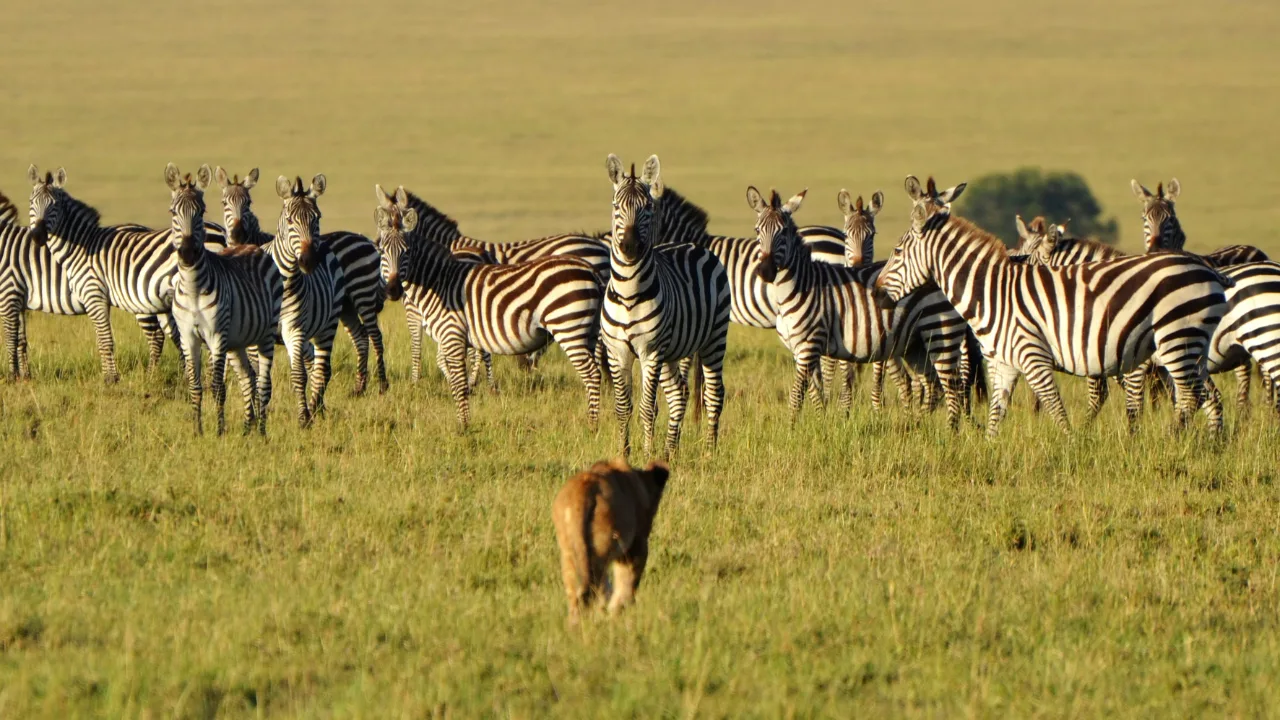
That reaction is designed for brief, specific danger. For example, when a zebra sees a lion, its body gets ready to run. Once it is safe, the threat is gone and its body gradually returns to normal.
So the problem is not that our body switches on the stress response. The problem appears when that response stays on for too long, even when there is no longer any threat. When the stress response is triggered constantly, or takes too long to switch off, your health is at risk.
The neuroscientist Bruce McEwen called this accumulated wear and tear allostatic load: the cost our body pays when it has to switch on the stress response again and again, and that wear brings many consequences. A review of several studies published in 2022 found that people with a high allostatic load had a 22% higher risk of dying from any cause and a 31% higher risk of dying from cardiovascular disease. A later review, published in 2024, also found a link between high allostatic load and heart disease.
These figures should be read with some caution. Not all studies measure allostatic load in the same way, as there is still no single, universal method for doing so. Even so, the results point to the same conclusion: keeping the stress response switched on for a long time can have serious consequences for our health.
Going back to the zebra and the lion: zebras don’t usually develop the same stress-related problems as humans, because when the lion is gone, the threat is gone too. The zebra goes back to grazing and its body returns to normal.
Humans work differently. We can trigger our stress response without any real or imminent danger in front of us. We can be sitting calmly at home on a Sunday and feel stressed just thinking about what Monday holds, or “ruminating” over some problem. And if we keep up those thoughts and worries for weeks or months, our body can stay on alert for a long time.
This happens mainly for three reasons:
The first is anticipation. Often we are not reacting to a danger that is happening now, but to something we imagine could happen. We worry, we go over and over what might go wrong or picture negative situations, and for our body, constantly thinking about a threat can be enough to trigger stress.
The second is conditioning. Our brain can learn to link certain places, sounds or situations with unpleasant experiences. Getting an email, hearing someone’s tone of voice or walking into a particular office can end up causing stress even when nothing dangerous is happening at that moment.
The third is avoidance. When something makes us anxious, it is natural to try to avoid it. The problem is that escaping usually brings immediate relief, and that relief makes us want to avoid it again next time. So a loop forms: we feel anxious, we avoid the situation, we feel better for a moment, and so we avoid it again. But by doing that, we never get the chance to find out that we might have been able to face the situation and handle it.
Put these three factors together and we can end up living as if that lion were chasing us every day, until we are tired and drained, worn down by a lion that doesn’t exist.
What work does to our body

Research on work stress has shown that what wears us down most is not necessarily having a lot of work, but facing high demands without enough control over how to respond to them. When demands go up and, at the same time, our ability to decide, organise or change what we do goes down, we start to feel trapped.
All of this can become harmful: you have a lot to bear and very little room to act. It is like being in the second rat’s cage, where everything happens around you but none of the important decisions are really in your hands.
In 2012, a large research consortium analysed almost 200,000 people over several years and found that those who combined high job demands with little control had a 23% higher risk of developing coronary heart disease. The people most affected were those who worked hard without being able to decide on or control what they did, and the risk rose especially when that strain came with an unhealthy lifestyle; those who looked after their health had roughly half as much disease.
Like much research, these findings should be taken with a pinch of salt and looked into further; some researchers have questioned whether the job-strain model is the best way to measure stress, since it is not the only one. But this model, like the animal experiments and the brain scans, is consistent in its results: the people who suffer the highest levels of stress are those who have no way to manage and control it.
Which leaves us with the next question: when stress is wearing you down, what do you do about it?
How to protect your health from stress

The answer is not simply to relax or think positive. If stress becomes more harmful when we feel we have no control, the key is to recover, little by little, the sense that our actions can change things.
1. Take back control where you can.
It is not about convincing yourself you are in control, but about finding what really depends on you. Even small decisions can reduce the feeling of powerlessness and help the brain leave its state of alert.
2. Create predictability.
Unpredictable stress is usually harder to bear. Having routines and schedules, and knowing when the hard part is coming, reduces uncertainty and gives structure to what felt chaotic.
3. Face what you avoid, little by little.
Avoiding something brings immediate relief, but it can keep fear and stress alive. Approaching what worries you gradually lets your body learn that it can tolerate it.
4. Bring back the things that do you good.
Chronic stress can make you drop activities, relationships and moments you used to enjoy. Bringing them back on purpose helps you recover wellbeing and break the stress loop.
5. Move.
Exercise helps regulate the body’s stress response. You don’t need to train to the limit; moderate, regular exercise can be more useful than intense, occasional efforts.
6. Build resilience through action.
Every time you solve a problem and see that your decisions have consequences, you strengthen your ability to face difficult moments in the future.


This article provides general information and is not medical or therapeutic advice. Mentions of diagnoses or therapy and treatment options are educational and do not mean they are available through Umana in your country.
Leave a Reply